Brazil Time Zones
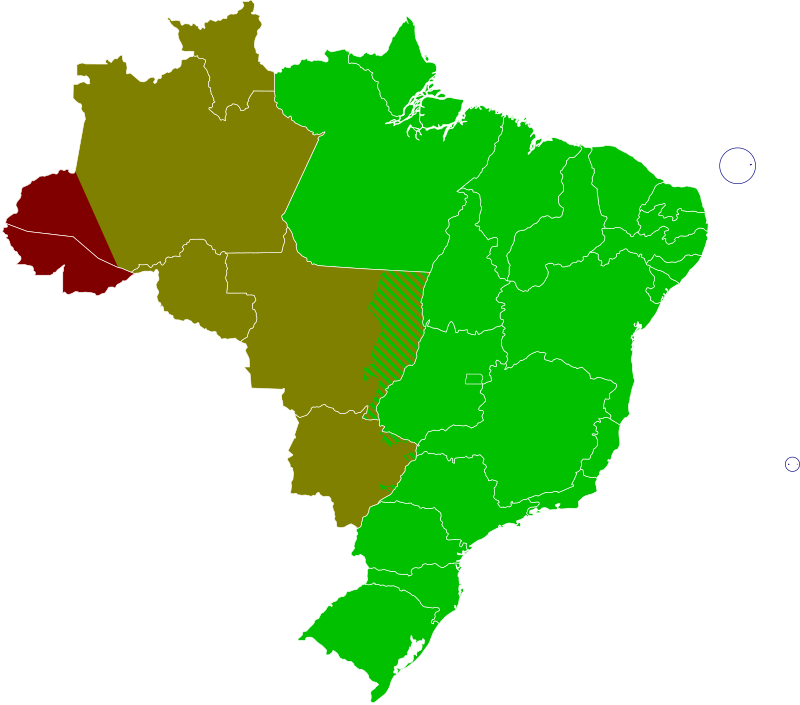
Live clocks for Brazil's 4 time zones, plus a static time zone map
Brazil ↔ Regional Compare
Compare Chicago and Miami (U.S. Eastern—same clock as New York) or Lisbon, London, Madrid, and Paris with Brazil’s primary time zones. Converter baseline is Brasilia Time (BRT, America/Sao_Paulo). Each row is a local day; the red marker is live local time.
Brazil has not used nationwide DST since February 2019. Offsets versus the United States and Europe now change only when the other side springs forward or falls back.
Brazil ↔ United States mainland
U.S. / Brasilia live converter
Live conversion vs Brasilia Time (01:52 BRT, America/Sao_Paulo). Positive hours = ahead of Brasilia.
| Remote zone | Local now | vs Brasilia | Brasilia |
|---|---|---|---|
| Central Daylight TimeCDT(UTC-5) · Chicago | 23:52 | -2h | 01:52 |
| Eastern Daylight TimeEDT(UTC-4) · Miami | 00:52 | -1h | 01:52 |
Hour-by-Hour Conversion Grid: Brasilia to Chicago & Miami
Hour-by-hour conversion from Brasilia Time. The first column is always Brasilia; city names and UTC offsets are in the table headers.
| BrasiliaUTC-03:00 | ChicagoUTC-05:00 | MiamiUTC-04:00 |
|---|---|---|
| 12:00 AM | 10:00 PM | 11:00 PM |
| 1:00 AM | 11:00 PM | 12:00 AM |
| 2:00 AM | 12:00 AM | 1:00 AM |
| 3:00 AM | 1:00 AM | 2:00 AM |
| 4:00 AM | 2:00 AM | 3:00 AM |
| 5:00 AM | 3:00 AM | 4:00 AM |
| 6:00 AM | 4:00 AM | 5:00 AM |
| 7:00 AM | 5:00 AM | 6:00 AM |
| 8:00 AM | 6:00 AM | 7:00 AM |
| 9:00 AM | 7:00 AM | 8:00 AM |
| 10:00 AM | 8:00 AM | 9:00 AM |
| 11:00 AM | 9:00 AM | 10:00 AM |
| 12:00 PM | 10:00 AM | 11:00 AM |
| 1:00 PM | 11:00 AM | 12:00 PM |
| 2:00 PM | 12:00 PM | 1:00 PM |
| 3:00 PM | 1:00 PM | 2:00 PM |
| 4:00 PM | 2:00 PM | 3:00 PM |
| 5:00 PM | 3:00 PM | 4:00 PM |
| 6:00 PM | 4:00 PM | 5:00 PM |
| 7:00 PM | 5:00 PM | 6:00 PM |
| 8:00 PM | 6:00 PM | 7:00 PM |
| 9:00 PM | 7:00 PM | 8:00 PM |
| 10:00 PM | 8:00 PM | 9:00 PM |
| 11:00 PM | 9:00 PM | 10:00 PM |
Brazil ↔ Europe
Europe / Brasilia live converter
Live conversion vs Brasilia Time (01:52 BRT, America/Sao_Paulo). Positive hours = ahead of Brasilia.
| Remote zone | Local now | vs Brasilia | Brasilia |
|---|---|---|---|
| Lisbon TimeUTC+01:00 (WEST) · Lisbon | 05:52 | +4h | 01:52 |
| London TimeUTC+01:00 (BST) · London | 05:52 | +4h | 01:52 |
| Madrid TimeUTC+02:00 (CEST) · Madrid | 06:52 | +5h | 01:52 |
| Paris TimeUTC+02:00 (CEST) · Paris | 06:52 | +5h | 01:52 |
Hour-by-Hour Conversion Grid: Brasilia to Lisbon, London, Madrid & Paris
Hour-by-hour conversion from Brasilia Time. The first column is always Brasilia; city names and UTC offsets are in the table headers.
| BrasiliaUTC-03:00 | LisbonUTC+01:00 | LondonUTC+01:00 | MadridUTC+02:00 | ParisUTC+02:00 |
|---|---|---|---|---|
| 12:00 AM | 4:00 AM | 4:00 AM | 5:00 AM | 5:00 AM |
| 1:00 AM | 5:00 AM | 5:00 AM | 6:00 AM | 6:00 AM |
| 2:00 AM | 6:00 AM | 6:00 AM | 7:00 AM | 7:00 AM |
| 3:00 AM | 7:00 AM | 7:00 AM | 8:00 AM | 8:00 AM |
| 4:00 AM | 8:00 AM | 8:00 AM | 9:00 AM | 9:00 AM |
| 5:00 AM | 9:00 AM | 9:00 AM | 10:00 AM | 10:00 AM |
| 6:00 AM | 10:00 AM | 10:00 AM | 11:00 AM | 11:00 AM |
| 7:00 AM | 11:00 AM | 11:00 AM | 12:00 PM | 12:00 PM |
| 8:00 AM | 12:00 PM | 12:00 PM | 1:00 PM | 1:00 PM |
| 9:00 AM | 1:00 PM | 1:00 PM | 2:00 PM | 2:00 PM |
| 10:00 AM | 2:00 PM | 2:00 PM | 3:00 PM | 3:00 PM |
| 11:00 AM | 3:00 PM | 3:00 PM | 4:00 PM | 4:00 PM |
| 12:00 PM | 4:00 PM | 4:00 PM | 5:00 PM | 5:00 PM |
| 1:00 PM | 5:00 PM | 5:00 PM | 6:00 PM | 6:00 PM |
| 2:00 PM | 6:00 PM | 6:00 PM | 7:00 PM | 7:00 PM |
| 3:00 PM | 7:00 PM | 7:00 PM | 8:00 PM | 8:00 PM |
| 4:00 PM | 8:00 PM | 8:00 PM | 9:00 PM | 9:00 PM |
| 5:00 PM | 9:00 PM | 9:00 PM | 10:00 PM | 10:00 PM |
| 6:00 PM | 10:00 PM | 10:00 PM | 11:00 PM | 11:00 PM |
| 7:00 PM | 11:00 PM | 11:00 PM | 12:00 AM | 12:00 AM |
| 8:00 PM | 12:00 AM | 12:00 AM | 1:00 AM | 1:00 AM |
| 9:00 PM | 1:00 AM | 1:00 AM | 2:00 AM | 2:00 AM |
| 10:00 PM | 2:00 AM | 2:00 AM | 3:00 AM | 3:00 AM |
| 11:00 PM | 3:00 AM | 3:00 AM | 4:00 AM | 4:00 AM |
Brazil’s four fixed time zones
Brazil uses four time zones. Brasília Time (UTC−3) covers the populous southeast—São Paulo, Rio de Janeiro, Belo Horizonte, and the federal capital—and dominates business, media, and flight schedules. Amazon Time (UTC−4) covers most of Amazonas (including Manaus), plus Rondônia, Roraima, Mato Grosso, and Mato Grosso do Sul. Acre Time (UTC−5) serves Acre and the far southwest of Amazonas. Fernando de Noronha (UTC−2) is a separate offset for the archipelago offshore.
Nationwide daylight saving ended after the final DST period concluded on 17 February 2019 and has not returned. Permanent abolition was later formalized by Federal Decree No.9.772 on 25 April 2019. Offsets are fixed year-round, which simplifies long-range planning but confuses callers who still assume São Paulo springs forward. When Brazil last used DST, states that observed it in the Southeast and Center-West moved to UTC−2 in southern summer; against U.S. Eastern Daylight Time that made São Paulo two hours ahead. Today São Paulo stays on UTC−3, so the same U.S. summer slot is only one hour ahead—a one-hour trap for anyone still using pre-2019 habits.
Internal Brazilian calls rarely cross more than two zones, but the gaps are real. A 9:00 AM meeting in São Paulo is 8:00 AM in Manaus and 7:00 AM in Rio Branco (Acre). Noronha is one hour ahead of Brasília; logistics for offshore operations should not automatically default to the São Paulo clock. Domestic flight times are quoted in local zone at origin and destination—a same-day connection westward can show an arrival “earlier” than departure on the itinerary header.
Amazonas has its own history of clock changes; Manaus currently stays on UTC−4 while Acre and the far southwest of Amazonas use UTC−5. Agricultural and commodity markets often quote “Brasília time” even when the story is about Manaus or Rio Branco on a different offset. Coastal hubs such as Belém and Fortaleza share Brasília Time with São Paulo (UTC−3)—they are not a fifth zone. U.S. East Coast teams dialing São Paulo should expect UTC−3 year-round: two hours ahead of Eastern Standard Time and one hour ahead of Eastern Daylight Time.
Use Chile time zones for the Santiago side of the border (Santiago still observes seasonal DST; see that page for current rules), or Chile and Brazil calls from the U.S. for cross-border scheduling with U.S. offices. Mainland U.S. context is on U.S. time zones; a common East Coast baseline is UTC to EST. For three or more cities, use the World Meeting Planner.
- Brasília / São Paulo: UTC−3, fixed since 17 February 2019 (no DST).
- Manaus: UTC−4; Acre and far southwest Amazonas: UTC−5; Fernando de Noronha: UTC−2.
- Legacy DST assumptions still cause one-hour errors in international invites.
Brazil Time Zones FAQ
How many time zones does Brazil have?
Brazil has four official time zones, from west to east: Acre Time (ACT), Amazon Time (AMT), Brasília Time (BRT), and Fernando de Noronha Time (FNT). The vast majority of Brazilians live on Brasília Time (UTC−03:00), including São Paulo, Rio de Janeiro, and the capital Brasília.
This page shows four live cards for those zones, with example cities Rio Branco, Manaus, São Paulo, and Fernando de Noronha. Brazil has not observed Daylight Saving Time nationwide since the final DST period ended on 17 February 2019.
What do Brazil’s time zones cover?
Below are the four zones on our map, with their UTC offsets and the IANA identifiers used by the clocks on this page.
Acre Time (IANA ID: America/Rio_Branco)
UTC−05:00 (ACT) year-round.
Covers the state of Acre and the far southwest of Amazonas. Two hours behind Brasília Time. Example city on this page: Rio Branco.
Amazon Time (IANA ID: America/Manaus)
UTC−04:00 (AMT) year-round.
Covers most of Amazonas, plus Mato Grosso, Mato Grosso do Sul, Rondônia, and Roraima. One hour behind Brasília Time. Example city on this page: Manaus.
Brasília Time (IANA ID: America/Sao_Paulo)
UTC−03:00 (BRT) year-round.
Covers most of Brazil’s population: the South and Southeast regions, nearly all of the Northeast, plus Center-West states on Brasília Time such as Goiás and the Distrito Federal (Brasília)—while Mato Grosso and Mato Grosso do Sul use Amazon Time instead. Main cities include São Paulo, Rio de Janeiro, Minas Gerais, Bahia, Belém, Fortaleza, and Brasília. Example city on this page: São Paulo.
Fernando de Noronha Time (IANA ID: America/Noronha)
UTC−02:00 (FNT) year-round.
Covers the Fernando de Noronha archipelago and related Atlantic islands off Brazil’s northeast coast. One hour ahead of Brasília Time. Example city on this page: Fernando de Noronha.
The map near the top of this page is a static color-coded image of Brazil’s time zones. It is not an interactive or region-by-region boundary tool.
How does Daylight Saving Time work in Brazil?
Nationwide daylight saving ended after the final DST period concluded on 17 February 2019; permanent abolition was formalized by Federal Decree No. 9.772 (25 April 2019). All four zones on this page stay on fixed standard offsets year-round.
Before that, DST had been used intermittently since the 1930s, and in later years it mainly applied to parts of the South, Southeast, and Center-West (roughly the Brasília Time heartland), usually starting at midnight on the first Sunday of November and ending at midnight on the third Sunday of February—moving those clocks to UTC−02:00. The North and the Atlantic islands often stayed on standard time even then.
What is the time difference across Brazil?
Relative to São Paulo / Brasília Time (UTC−03:00 year-round on this page), the gaps are fixed:
- Rio Branco (Acre): 2 hours behind.
- Manaus (Amazon): 1 hour behind.
- Fernando de Noronha: 1 hour ahead.
Because Brazil no longer changes clocks, these differences remain the same throughout the year. Against U.S. Eastern Time, Brasília Time is two hours ahead of EST and one hour ahead of EDT—the U.S. side still moves, so the international gap changes with the Northern Hemisphere seasons even though Brazil does not.
For cities outside Brazil, use Brazil ↔ Regional Compare above to line up U.S. or European zones next to Brasília Time. You can also open neighboring Chile time zones (Santiago still has seasonal DST), read Chile and Brazil calls from the U.S., check the U.S. time zone page, or plan several cities in the World Meeting Planner.
Who sets Brazil’s time zones?
Brazil’s legal time zones are set at the federal level. The national government defines the zone map and whether Daylight Saving Time applies; states do not each invent their own permanent offset.
That federal authority is also how DST was ended for the whole country: the last seasonal clocks fell back on 17 February 2019, and Decree No. 9.772 (25 April 2019) made the abolition permanent after energy studies found little benefit from seasonal clock changes.
A brief history of Brazil’s time zones
Brazil’s four-zone pattern reflects a wide country: from Acre near Peru to islands in the Atlantic. The map has been adjusted several times. Acre Time was consolidated into Amazon Time in 2008 meaning Brazil briefly operated with three official time zones. federal law later reinstated UTC−05:00 for Acre and southwest Amazonas, with the switch taking effect on 10 November 2013, returning Brazil to four official zones.
Daylight Saving Time ran for decades in various forms, then ended after 17 February 2019, with permanent abolition under Decree No. 9.772 (25 April 2019). Since then, Brazilian clocks no longer spring forward or fall back.
Where does this page get its time data?
The clocks and zone labels on this page follow the IANA Time Zone Database: America/Rio_Branco, America/Manaus, America/Sao_Paulo, and America/Noronha. All four stay on fixed offsets year-round. For a broader overview of Brazilian time zones, see Time in Brazil (opens in new tab).
Time data: IANA / TZDB Last verified: July 21, 2026 About Contact