Chile Time Zones
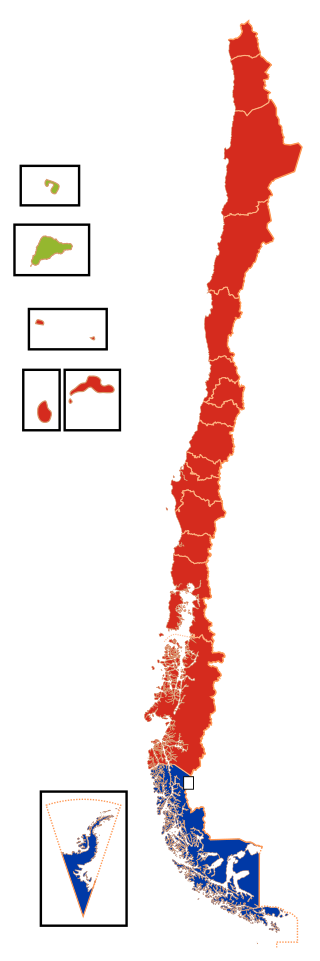
Live clocks for continental Chile, Aysén/Magallanes, and Easter Island, plus a static time zone map
Chile ↔ Regional Compare
Compare Los Angeles and New York (Miami uses the same Eastern clock) or Madrid, London, and Paris with Chile’s primary time zones. Converter baseline is Santiago (Continental Chile Time, America/Santiago). Each row is a local day; the red marker is live local time.
Continental Chile still observes DST in the southern summer (roughly September to April). That is the opposite season from the United States and Europe, so the same city pair can shift by an hour twice a year even when both sides “only” change once.
Chile ↔ United States mainland
U.S. / Santiago live converter
Live conversion vs Santiago (21:39 CLST, America/Santiago). Positive hours = ahead of Santiago.
| Remote zone | Local now | vs Santiago | Santiago |
|---|---|---|---|
| Pacific Daylight TimePDT(UTC-7) · Los Angeles | 17:39 | -4h | 21:39 |
| Eastern Daylight TimeEDT(UTC-4) · New York | 20:39 | -1h | 21:39 |
Hour-by-Hour Conversion Grid: Santiago to Los Angeles & New York
Hour-by-hour conversion from Santiago (Continental Chile Time). The first column is always Santiago; city names and UTC offsets are in the table headers.
| SantiagoUTC-03:00 | Los AngelesUTC-07:00 | New YorkUTC-04:00 |
|---|---|---|
| 00:00 | 20:00 | 23:00 |
| 01:00 | 21:00 | 00:00 |
| 02:00 | 22:00 | 01:00 |
| 03:00 | 23:00 | 02:00 |
| 04:00 | 00:00 | 03:00 |
| 05:00 | 01:00 | 04:00 |
| 06:00 | 02:00 | 05:00 |
| 07:00 | 03:00 | 06:00 |
| 08:00 | 04:00 | 07:00 |
| 09:00 | 05:00 | 08:00 |
| 10:00 | 06:00 | 09:00 |
| 11:00 | 07:00 | 10:00 |
| 12:00 | 08:00 | 11:00 |
| 13:00 | 09:00 | 12:00 |
| 14:00 | 10:00 | 13:00 |
| 15:00 | 11:00 | 14:00 |
| 16:00 | 12:00 | 15:00 |
| 17:00 | 13:00 | 16:00 |
| 18:00 | 14:00 | 17:00 |
| 19:00 | 15:00 | 18:00 |
| 20:00 | 16:00 | 19:00 |
| 21:00 | 17:00 | 20:00 |
| 22:00 | 18:00 | 21:00 |
| 23:00 | 19:00 | 22:00 |
Chile ↔ Europe
Europe / Santiago live converter
Live conversion vs Santiago (21:39 CLST, America/Santiago). Positive hours = ahead of Santiago.
| Remote zone | Local now | vs Santiago | Santiago |
|---|---|---|---|
| Madrid TimeUTC+02:00 (CEST) · Madrid | 02:39 | +5h | 21:39 |
| London TimeUTC+01:00 (BST) · London | 01:39 | +4h | 21:39 |
| Paris TimeUTC+02:00 (CEST) · Paris | 02:39 | +5h | 21:39 |
Hour-by-Hour Conversion Grid: Santiago to Madrid, London & Paris
Hour-by-hour conversion from Santiago (Continental Chile Time). The first column is always Santiago; city names and UTC offsets are in the table headers.
| SantiagoUTC-03:00 | MadridUTC+02:00 | LondonUTC+01:00 | ParisUTC+02:00 |
|---|---|---|---|
| 00:00 | 05:00 | 04:00 | 05:00 |
| 01:00 | 06:00 | 05:00 | 06:00 |
| 02:00 | 07:00 | 06:00 | 07:00 |
| 03:00 | 08:00 | 07:00 | 08:00 |
| 04:00 | 09:00 | 08:00 | 09:00 |
| 05:00 | 10:00 | 09:00 | 10:00 |
| 06:00 | 11:00 | 10:00 | 11:00 |
| 07:00 | 12:00 | 11:00 | 12:00 |
| 08:00 | 13:00 | 12:00 | 13:00 |
| 09:00 | 14:00 | 13:00 | 14:00 |
| 10:00 | 15:00 | 14:00 | 15:00 |
| 11:00 | 16:00 | 15:00 | 16:00 |
| 12:00 | 17:00 | 16:00 | 17:00 |
| 13:00 | 18:00 | 17:00 | 18:00 |
| 14:00 | 19:00 | 18:00 | 19:00 |
| 15:00 | 20:00 | 19:00 | 20:00 |
| 16:00 | 21:00 | 20:00 | 21:00 |
| 17:00 | 22:00 | 21:00 | 22:00 |
| 18:00 | 23:00 | 22:00 | 23:00 |
| 19:00 | 00:00 | 23:00 | 00:00 |
| 20:00 | 01:00 | 00:00 | 01:00 |
| 21:00 | 02:00 | 01:00 | 02:00 |
| 22:00 | 03:00 | 02:00 | 03:00 |
| 23:00 | 04:00 | 03:00 | 04:00 |
Chile’s seasonal clocks and regional exceptions
Continental Chile uses Chile Standard Time (CLT, UTC−4) and Chile Summer Time (CLST, UTC−3), typically from September through early April in the Southern Hemisphere, with exact dates varying by year. Santiago, Valparaíso, and Concepción follow that cycle. Exact transition dates are set by national decree and have shifted in recent years; do not rely on a memorized U.S.-style “second Sunday in March” rule when booking months ahead.
In the far south, Magallanes (including Punta Arenas and Puerto Natales) has stayed on UTC−3 year-round since 2017 (timeanddate report). Aysén joined that permanent UTC−3 clock in 2025 (it no longer falls back with Santiago; see the 2025 announcement and Decreto Nº 93). Patagonia itineraries that list “Chile time” without a city can be wrong by one hour between Santiago and Punta Arenas during months when the capital is on standard time. Cruise and expedition operators frequently publish embarkation times in local port zone; verify Aysén/Magallanes separately from the Santiago clock.
Easter Island (Rapa Nui) uses UTC−6 standard and UTC−5 daylight—typically two hours behind continental Chile, although the gap may differ briefly around DST transitions. Administrative ties to Santiago do not imply a shared wall clock. Flight schedules between Santiago and Mataveri International Airport use local airport times, so travelers should expect about a two-hour local-time difference for most of the year.
Mining, agriculture, and export-industry conference calls often list Santiago as the reference city while suppliers operate from Antofagasta (same continental rules) or Punta Arenas (Magallanes year-round UTC−3). Mining shifts published in “Chilean time” without a region have caused payroll disputes when mainland Chile returns to standard time around April but the far south stays on UTC−3. Calendar tools that auto-detect “Chile” may default to America/Santiago and misplace Patagonia or Easter Island attendees if the city is not specified.
U.S. callers often misread the season because Chilean summer overlaps Northern Hemisphere winter. A January call from New York (usually EST, UTC−5) to Santiago (CLST, UTC−3) is usually two hours apart. In July, Santiago is usually on CLT (UTC−4) while New York is on EDT (UTC−4), so the cities often share the same offset—closer than the January gap, not farther. Seasonal tables: Chile and Brazil calls from the U.S.; fixed-offset neighbor Brazil; mainland U.S. context on U.S. time zones. For three or more cities, use the World Meeting Planner.
- Mainland: CLT UTC−4 standard, CLST UTC−3 summer; transition dates vary by year.
- Magallanes: fixed UTC−3 since 2017; Aysén: fixed UTC−3 since 2025—not tied to Santiago’s seasonal shift.
- Easter Island: UTC−6 / −5—typically two hours behind continental Chile, with brief gaps possible around DST transitions.
Chile Time Zones FAQ
How many time zones does Chile have?
Chile has three civilian time zones represented on this page: Easter Island Time, Continental Chile Time (most of the mainland, including Santiago), and a year-round UTC−03:00 zone for Aysén and Magallanes (including Punta Arenas).
This page shows three live cards, with example places Hanga Roa (Easter Island), Santiago, and Punta Arenas. Most Chileans live on Continental Chile Time, which still changes for Daylight Saving Time.
What do Chile’s time zones cover?
Below are the three zones on our map, with their usual UTC offsets and the IANA identifiers used by the clocks on this page.
Easter Island Time (IANA ID: Pacific/Easter)
Standard: UTC−06:00 | Daylight: UTC−05:00.
Covers Rapa Nui (Easter Island). It follows Chile’s DST calendar, but clocks change at 22:00 local time on the changeover Saturday—the same UTC moment as the mainland’s usual midnight-into-Sunday transition. Example city on this page: Hanga Roa.
Continental Chile Time (IANA ID: America/Santiago)
Standard: UTC−04:00 (CLT) | Daylight: UTC−03:00 (CLST).
Covers most of continental Chile, including Santiago, Valparaíso, Concepción, and the north. This is the main national clock. Example city on this page: Santiago.
Aysén / Magallanes Time (IANA ID: America/Punta_Arenas)
UTC−03:00 year-round (no DST).
Covers Región de Aysén and Magallanes (including Punta Arenas). Magallanes has stayed on permanent UTC−03:00 since 2017; Aysén adopted the same year-round UTC−03:00 offset in 2025 (see Decreto Nº 93 (opens in new tab); also Magallanes 2017 / Aysén 2025 (opens in new tab)). Example city on this page: Punta Arenas. IANA represents Aysén as America/Coyhaique; this page’s live card uses America/Punta_Arenas because both currently share the same fixed UTC−03:00 offset.
The map near the top of this page is a static color-coded image of Chile’s time zones. It is not an interactive or region-by-region boundary tool.
How does Daylight Saving Time work in Chile?
On Continental Chile and Easter Island, clocks usually spring forward one hour around September and fall back one hour around April. Exact transition dates are set by government decree each year. On the mainland, the change usually takes effect at midnight at the start of Sunday. Recent examples: in 2025, Santiago fell back on 6 April and sprang forward on 7 September (both at 00:00 local); in 2026, the corresponding dates are 5 April and 6 September.
Easter Island generally uses the same weekends, but the local clock reads 22:00 on the changeover Saturday because it sits about two hours behind Santiago—the UTC instant matches the mainland midnight transition. Aysén and Magallanes do not spring forward or fall back; they stay on UTC−03:00 all year.
Southern Hemisphere note: Chile’s DST season runs through the southern summer—roughly September to April—so during much of the U.S. winter, much of Chile may still be on daylight time, and the reverse is often true around the U.S. summer.
What is the time difference across Chile?
Relative to Santiago (America/Santiago):
- Hanga Roa (Easter Island): typically 2 hours behind Santiago when DST schedules align; exact changeover dates or hours can differ briefly around transitions.
- Punta Arenas (Aysén / Magallanes): same clock as Santiago in southern summer (both UTC−03:00); 1 hour ahead of Santiago in southern winter, when Santiago falls back to UTC−04:00.
Tip for U.S. readers: Santiago is often closer to Eastern U.S. time in the U.S. summer (around June–August), when both sides are commonly on UTC−04:00 (CLT and EDT). During much of the U.S. winter, New York is usually on EST (UTC−05:00) while Santiago is on CLST (UTC−03:00)—about two hours apart.
For cities outside Chile, use Chile ↔ Regional Compare above to line up U.S. or European zones next to Santiago. You can also open seasonal tables in Chile and Brazil calls from the U.S., refer to the Brazil time zones page for this fixed-offset neighbor, check the U.S. time zone page, or plan several cities in the World Meeting Planner.
Who sets Chile’s time zones?
Chile’s official time is set by the national government through decrees (historically under the Interior ministry), not by each region inventing its own permanent offset. Those decrees define continental time, Easter Island time, and which southern regions stay on UTC−03:00 year-round.
That national authority is why Magallanes (and later Aysén) could adopt a permanent UTC−03:00 offset while Santiago keeps changing clocks for DST.
A brief history of Chile’s time zones
Chile has changed DST dates and offsets many times. Mainland Chile long used seasonal time; Easter Island kept a separate, more westerly offset. Magallanes locked to permanent UTC−03:00 in 2017; Aysén later moved onto that same year-round clock (see coverage notes above for 2025 sources).
Today’s pattern is: Santiago and most of the country still observe DST; Aysén/Magallanes stay put; Easter Island keeps its own offset and local transition hour.
Where does this page get its time data?
The clocks and zone labels on this page follow the IANA Time Zone Database: Pacific/Easter, America/Santiago, and America/Punta_Arenas (with America/Coyhaique available for Aysén). Santiago and Easter Island both observe Chile’s DST rules, with different local transition times; Punta Arenas stays on UTC−03:00 year-round. For a broader overview, see Time in Chile (opens in new tab).
- Mainland: CLT UTC−4 / CLST UTC−3; September–April DST dates vary by decree.
- Magallanes (since 2017) and Aysén (since 2025): fixed UTC−3 year-round.
- Easter Island: UTC−6 / −5—typically two hours behind Santiago when schedules align.
Time data: IANA / TZDB Last verified: July 21, 2026 About Contact